

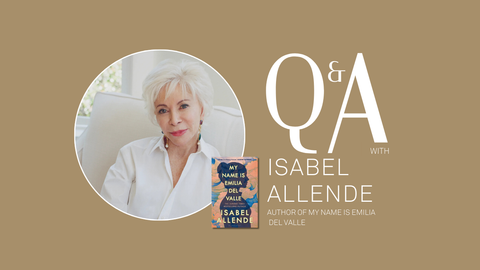
Q: Your writing has always drawn on reflections from your own experiences regarding history and politics. How has that shaped your approach to My Name is Emilia del Valle?
A: I was interested in the civil war that happened in Chile in l891 because it had similarities to the political situation in Chile l973, when we had a military coup. I left my country because I couldn’t live in fear and became an exile in Venezuela. That event was one of the crossroads in my life; everything changed and I to start from scratch somewhere else. It was easy for me to put myself in the place of Emilia.
Q: The storytelling in this book is quite epic, blending beautiful writing with incredible and rich character histories and complexities? Besides your own history as a prolific author, how do you approach achieving this on the page?
A: I am interested in people, relationships and emotions. The epic and historic events are the background, or better said the stage where the characters live. I believe I connect to my readers in so many different languages because we are all emotional beings; we can relate to the feelings of others, even to fictional characters in a novel.
Q: What was the research process like?
A: Research is the foundation of the book; it gives me half of the story. Once I have a clear idea of the place, the time and the relevant events, I can weave in the lives of my characters. I do a lot of research in books, historic documents and on the internet. Soon I hope I will be using AI. My brother Juan, who is a retired scholar, helps me find unusual and obscure material. I prepare the basic research before I start the book, but in the process of writing I fill in much more. Often, I find myself drowned in information, but I have learned to pick and choose. The research should not be obvious to the reader, it must blend into the story seamlessly.
Q: How do you balance fiction with historical fact?
A: I am very precise regarding historical facts. An attentive reader can easily notice when the facts are distorted, not to mention reviewers and historians. The plot must adapt to those facts, not the other way around.
Q: The Chilean Civil War is also represented in a way that highlights the impact of war, drawing back to your intentions as a writer to reflect on the way history and politics shapes society. What can you tell us about this?
A: My Name is Emilia del Valle is a novel about war. Of course there’s much more in it, but the inspiration was the civil war in Chile, a brutal event. More Chileans died during the four months of the civil war than during the four years of the war against Peru and Bolivia. Most soldiers didn’t even know why they were fighting against their own brothers. They were recruited or drafted, they were mostly young men uneducated and poor. All armed conflicts are disastrous for the civilian population. We can see the effects of war today in so many places around the globe. There are 117 million refugees in the world, most are escaping from violence, most are women and children.
Q: The emotive experience of the reader seemed important to me amongst the illustrative descriptions of this book. As a writer, how do you nail down an effective technique of capturing a sense of time and place?
A: The research gives me a sense of time and place. I have to imagine that my characters live in that time and in that place. Gender, class, race, culture, social and political issues also determine their lives. But ultimately the similarities among people are many more than the differences, so even when I write about characters that live in the past I know how they think and feel. We all share the same basic emotions, fear, love, hope, loyalty, greed, etc.
Q: Besides the setting and epic plot, your characters add another layer of heart to the story. For instance, Emilia as a character was a fantastic way to explore the experiences of women during the late 19th century. She’s independent but experiences quite the journey, what can you tell readers about her?
A: Women in the XIX century had very few options, no economic resources, limited education, no independent place in the society. They were subordinate to men in every aspect of their lives. However, there were exceptions. Emilia had two superpowers: she was brave, and she could write. Her beloved stepfather, a modest schoolteacher, helped her to develop both her courage and her writing; he gave her the self confidence that she needed to fend for herself in a world run by men. She became a journalist in the San Francisco newspaper Daily Examiner and at some point she was sent as a war correspondent to Chile at a time when that was unthinkable for a woman.
Q: Can you tell us about some of the other characters readers will come across in the book?
A: Emilia’s parents are quite unique, the mother is a former nun seduced by a Chilean aristocrat in San Francisco, gets pregnant of Emilia and marries a Mexican school teacher. In Chile Emilia meets her dying biological father thanks to a formidable character, Paulina del Valle, a tough matriarch that appears also in my novels Daughter of Fortune and Portrait in Sepia. As you can see, this book is part of Del Valle family saga that started in The House of the Spirits. Eric Whelan is Emilia’s best friend and mentor at the newspaper. He accompanies her to the war. There are many other characters, including some historical figures, like President José Manuel Balmaceda, who committed suicide when he lost the war, and several others.
Q: If readers could take away three things from this book, what would they be and why
A: I never intend to put ideas in the reader’s mind. Each person reads the book with their own perspective, they experience, memories and beliefs. Each one can reach his or her own conclusions. My job is to tell a story, that’s all.