

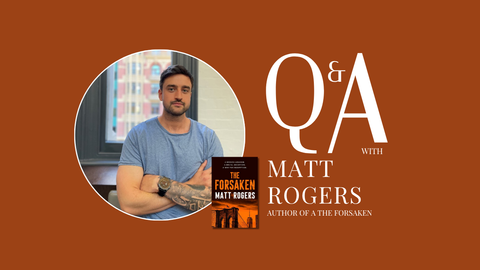
Q: While an action-packed thriller, your story is emotionally anchored with ideas of philosophy and understanding why people do the things they do. Is this something you wanted to explore?
A: Absolutely, and it’s something I’ve been steadily working into my novels more and more over the last few years. I think what often draws us to thrillers is reading about characters dealing with some of the most harrowing and terrifying situations imaginable, and seeing how they persevere through these challenges.
Q: We know that Ryan Holiday and his practices have had a big impact on you as a writer, would you say this is the same for your characters?
A: Even though stoicism isn’t specifically referenced in The Forsaken, there are definitely themes from that school of philosophy running throughout. A lot of people think being “stoic” means suppressing your emotions, but it actually involves separating the world into what you can and can’t control, thereby allowing you to do your very best with the cards you were dealt. Logan and Alice, the protagonists of The Forsaken, most definitely grapple with these ideas throughout the book, because so many terrible things happen to them that they can’t control. Their question becomes how to move forward in spite of their horrible circumstances, or how to say yes to life in spite of its horrors.
Q: Bringing it back to The Forsaken, where did the idea for this book come from?
A: The original idea for this book was for an assassin to have unwittingly served the U.S. government their whole career without even realising. From there, the rest of the novel built out.
Q: Tell us a bit about your protagonist Logan Booth.
A: Logan Booth is an individualist who spent a decade killing targets for what he thought was a rogue band of vigilantes hellbent on addressing injustice. The Forsaken opens eight months after Logan learns he was only ever being manipulated by the CIA to further government interests. He spends his days drowning himself in liquor, painfully aware that he might have killed people who didn't deserve it.
Q: Another key character was Alice, who completely pulled me in with her characterisation and voice, can you give us insight into her
A: Alice Mason is a young woman living alone on the streets of Brooklyn. After a turbulent upbringing in small-town Massachusetts by a mother afflicted with borderline personality disorder, Alice spiralled into addiction and wound up homeless in New York. In The Forsaken, she inadvertently becomes a key witness in a plot to kill Logan's only remaining friend, investigative reporter Jorge Romero.
Q: A big part of a thriller is finding ways to keep the audience turning the pages. How do you feel you achieve this?
A: I think if you give your book’s characters the most harrowing and intense challenges you can imagine, it gets the reader invested very quickly. My thrillers are always dark and deal with intense subjects because that’s what I personally love to read.
Q: As a writer, how do you approach building tension, suspense and edge of your seat thrills?
A: My best advice for building tension and creating thrills is to make everything you write as visceral as you possibly can. This applies mostly to thrillers, because by definition thrillers deal with intense and harrowing situations, and the way I see it, the more visceral, the better. The harder you feel what your characters are going through, the more you want to keep reading to see what happens to them.
Q: What does a typical writing day look like for you?
A: When I’m writing a novel, I usually write 1,500 words a day. This takes me 2-3 hours of deep, focused, uninterrupted work, and I try to do this seven days a week. So instead of the traditional 9-5 schedule 5 days a week, I’m doing a few hours of work every single day. This helps make writing a habit and I’ve found it takes me less willpower to sit down at my keyboard and get typing if it’s just something I’m used to doing every day. I don’t burn out either, because I’m never putting a ridiculous amount of work in on one particular day. It’s just steady and consistent.
Q: You’ve been writing and publishing since you were 18, what is something you would tell 18-year-old Matt after everything you’ve learnt?
A: I’m very fortunate in that I decided to approach my writing career in a certain way when I first started out, and it ended up paying off. Since I was 18 I’ve just stayed consistent with my writing, publishing a full-length novel every 3-4 months. This resulted in 36 novels self-published, which was the best learning experience I could have possibly had – I consider it my informal degree in creative writing. So I’d probably tell 18-year-old Matt to just keep doing what you’re doing and stay focused on always trying to improve your work.
Q: This is your first traditionally published book. What has the process been like for you?
A: It’s been such a fantastic experience. The collaboration involved with every part of the publishing process is something I was never able to experience when I was self-published, and I’ve loved every minute of it. It’s a much longer process but the build-up is slow for a reason, because there’s so much more to coordinate than a self-published launch. I’m grateful for how much Simon & Schuster Australia has backed this novel.
Q: Can you tell us a bit about why you thought this was the book you wanted to be traditionally published?
A: I’d seen what happened with I Am Pilgrim by Terry Hayes becoming a runaway bestseller, with word-of-mouth leading to a crazy number of sales, and when I wrote the first 60 pages of The Forsaken, I knew it was the best story idea I’d ever had and was determined to get it traditionally published. I wrote those first 60 pages in 2021, and then sat on them for a couple of years just waiting for the right opportunity. I’m thrilled to have found it with Simon & Schuster!
Q: What was your journey to publication like?
A: I started reading when I was four years old and writing fiction when I was six. I wrote basically every day of my life growing up, and wrote my first full-length novel as a teenager. It was a young-adult action-sci-fi novel about a teenage boy recruited to fight mutants. I tried and failed to get that book traditionally published in my teens, which turned my attention to self-publishing. I wrote my first adult thriller at 18 and self-published it on Amazon. It took off and I spent nine years self-publishing as my full-time job, and was fortunate enough to sell over a million copies self-published. I wrote 36 thriller novels during this time. Then in 2023, I sent The Forsaken to an Australian agent, Daniel Pilkington, and he got me the deal with Simon & Schuster. So it was a long and eventful journey to traditional publication.
Q: As with any job, there are hard days. How do you push through when the words aren’t flowing?
A: The way I like to look at it is, say I was an accountant, I wouldn’t get to claim to have “accountant’s block” and not show up to my job. So I don’t believe in writer’s block. This is my job and it’s what I do for a living, so I show up to work and write. Some days are harder than others, but that’s okay. The point is that I prove to myself I can get the work done anyway, thereby entrenching it as habit. And the more I write, the better I get at writing. I live by the famous Stephen King quote: “If you want to be a writer, you must do two things above all else: read a lot and write a lot.”